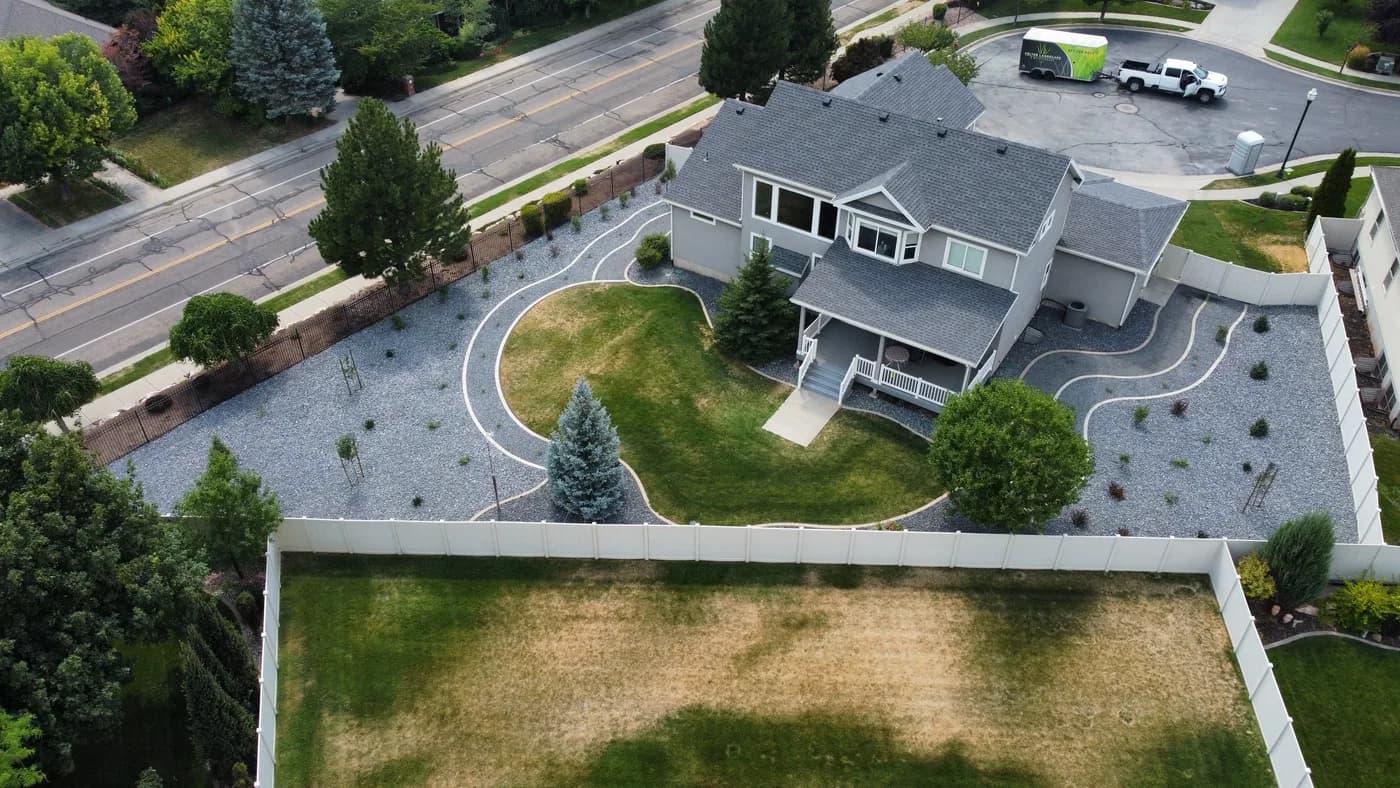
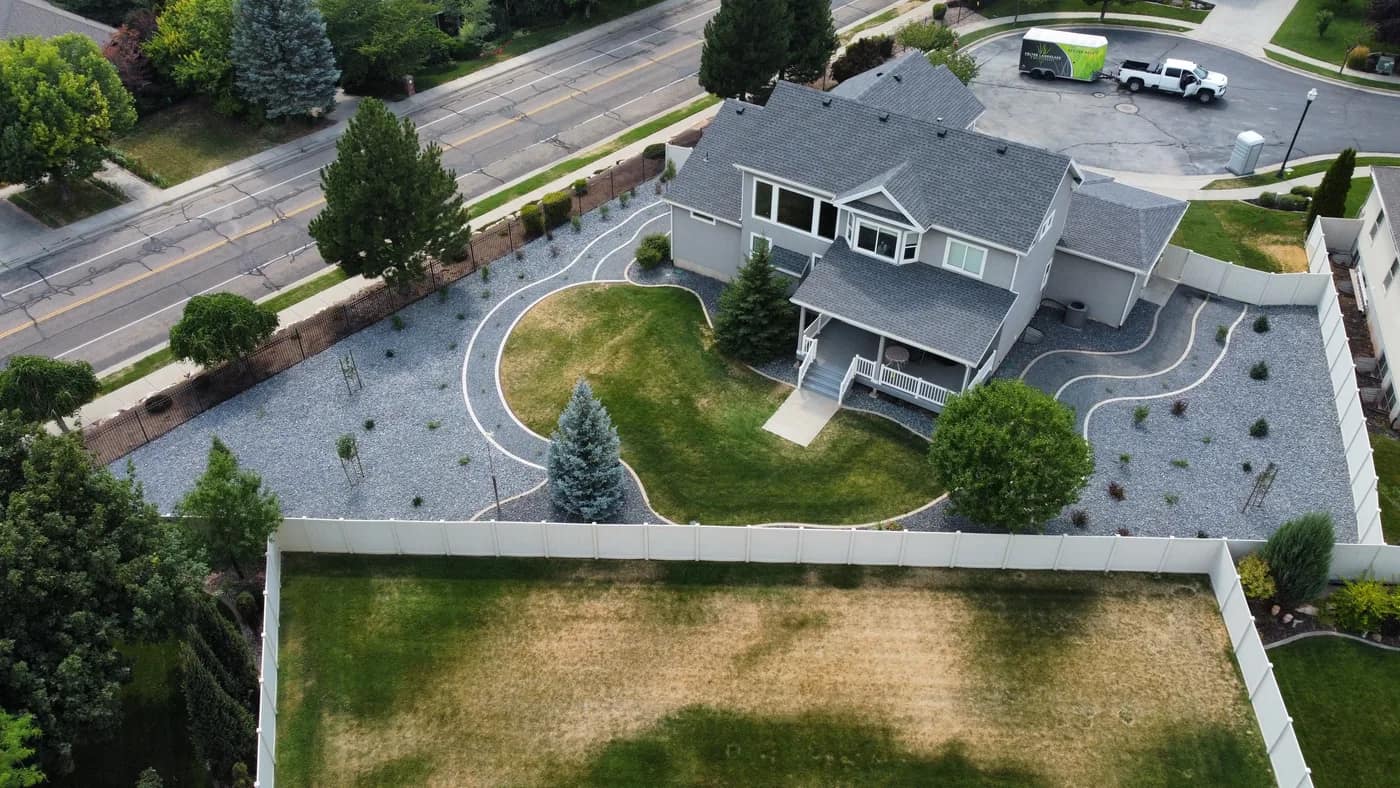
We took about 5,500 square feet of lawn out of a South Ogden yard and put back planting beds, gravel, concrete-edged paths, and a curved lawn area near the house. We were on site eight working days and in and out in less than two weeks. The homeowner went through Weber Basin's Landscape Lawn Exchange, which pays by the square foot for lawn you remove.
The rules are not complicated, but one of them will cost you the entire payment if you get the order wrong. Here is the program described from a finished yard instead of from the brochure.
What the program pays
Weber Basin's Landscape Lawn Exchange pays $1.25 or $2.50 per square foot of qualifying lawn removed, and the rate depends on your city. Every city in the district now qualifies for one rate or the other. South Ogden is currently on the $2.50 list. North Ogden is currently on the $1.25 list, so do not assume a neighboring city pays what yours does.
At $2.50 per square foot, removing about 5,500 qualifying square feet works out to roughly $13,750. That figure is arithmetic on an approximate area rather than a check anyone has waved at us. The money also arrives at the end instead of the beginning: Weber Basin pays after the work is finished and passes a final inspection, and the check can take up to three weeks after that.
A few limits to plan around:
- Your project has to remove at least 250 square feet of existing, living lawn
- The maximum incentive is $50,000 per property
- Funding is first come, first served, and applications can be paused or denied if the funds run out, though approved projects keep the funding they were granted
- Weber Basin calls this an incentive rather than a rebate, and the distinction is real: nothing is reimbursed, and nothing is paid up front
The rule that disqualifies people
You have to apply before any grass comes out. Only lawn that is living and present at the initial site visit counts toward the incentive, and Weber Basin's rules say plainly that you will not qualify if the lawn has already been removed. Pull the strip out over a motivated weekend and apply afterward, and the area you removed no longer counts.
The order that works is application first, then a virtual site visit over Zoom where Weber Basin looks at the area and answers questions, then a notarized program agreement and a W-9. Then you wait for your approval. Weber Basin's rules put it bluntly: do not remove any lawn until your application is approved. Signing the paperwork is not the green light, and only after the approval comes back does anyone touch the lawn. Put that whole sequence in your timeline instead of treating it as paperwork to catch up on.
Planting and mulch requirements
This is not a program for replacing grass with nothing. Over the lawn removal area, you need enough new planting that at least 35 percent of it will be covered by plants at maturity. Existing plant coverage does not count toward that 35 percent unless Weber Basin staff have documented in writing that there is already enough. Annual flowers and vegetable beds do not count as coverage either.
These requirements also have to be in the plan when the project is designed and priced:
- Three to four inches of mulch, which can be bark, rock, or gravel
- One medium or large drought-tolerant shade tree per 3,000 square feet of project area, though Weber Basin allows exceptions for smaller project areas, for areas already under tree canopy, and for overhead power lines
- Low-volume drip irrigation to the planting areas, with a visible filter and pressure regulator, emitters rated at five gallons per hour or less, and drip on separate valves from any spray
- Park strips are exempt from the plant coverage requirement as long as the strip complies with local landscape code
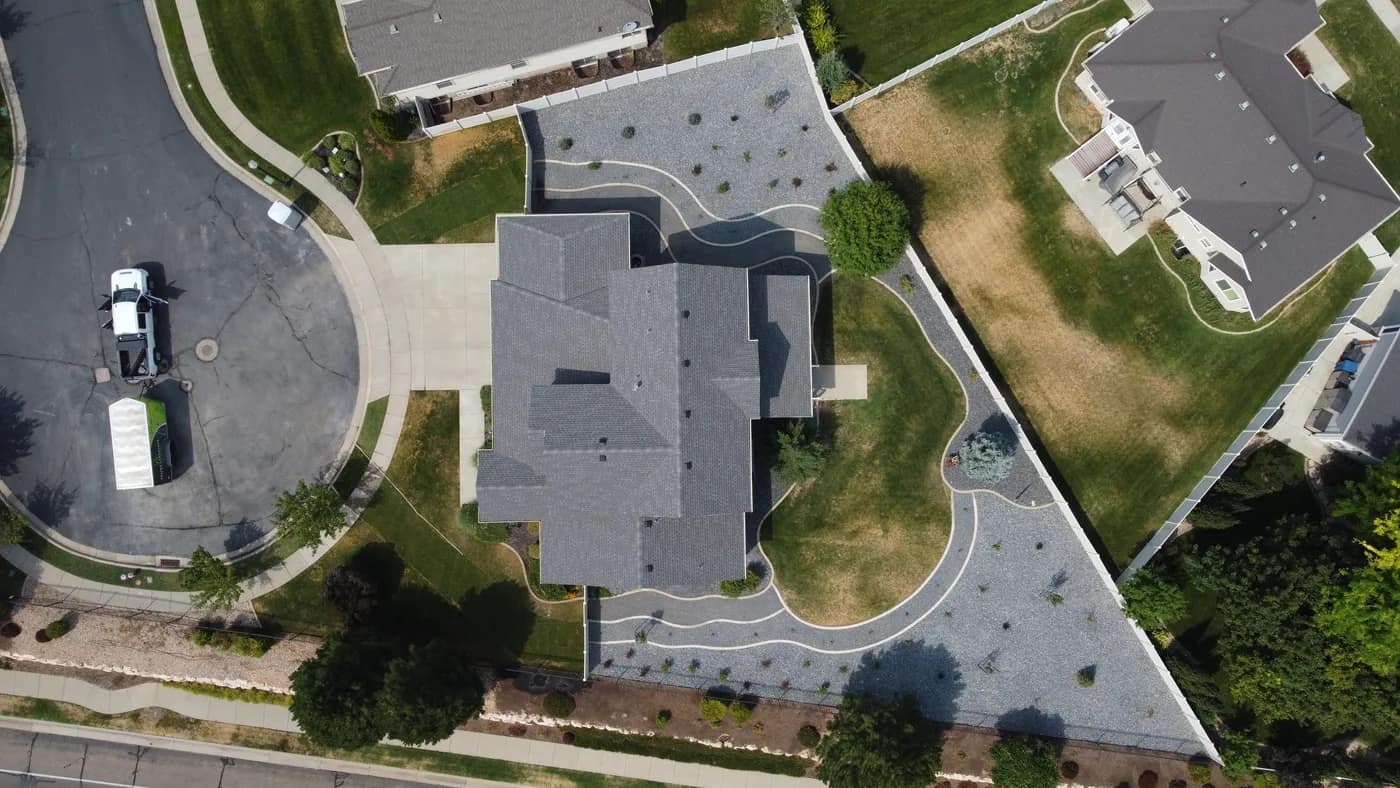
Look at the overhead photo and the new plants read small. That is what a freshly planted conversion looks like, and it is why the coverage standard is measured at maturity instead of on install day. The plan has to show the 35 percent arriving as the plants reach mature size.
What does not qualify
Several popular ideas are specifically excluded, and finding that out after the design is drawn is an expensive way to learn it. The program does not pay for lawn replaced with artificial turf, concrete, or hardscape. It does not pay for lawn replaced with another kind of grass, including drought-tolerant turfgrass. And it does not pay to redo areas that are already drip irrigated, mulched, rocked, or planted, because this is a lawn replacement program rather than a landscape refresh.
You do not have to remove all of it
The yard in these photos kept a curved lawn area near the house. The incentive is paid on the qualifying area you remove, so you can keep the lawn that earns its place and convert the rest.
Park strips are the usual starting point, and we work through how we prioritize the rest of a yard in the park strip conversion post. It matters more every year now that secondary water is metered against a seasonal allotment, which we covered in the secondary water meters post.
How long a conversion like this takes
Eight working days on site, finished inside two weeks. That is the build. The full calendar is longer, because the application, the virtual site visit, and the signed agreement all happen before we start, and the final inspection and the check both happen after we leave.
Timing the build into spring or fall helps the plants establish, and those windows book up early. We wrote about which windows work in Northern Utah and how far ahead they fill in the best time to landscape post.
If you are thinking about it
A conversion this size is a design job before it is a demolition job, because the 35 percent coverage, the tree requirement, and the drip layout all have to exist on paper before Weber Basin approves anything. We handle the plan, the plant selection, the drip, and the install. Landscape design is quoted separately and up front, and the build is quoted once the plan exists. Our landscape design page walks through how that works, and you can request a free quote whenever you want to talk through your own yard.
Common questions
How much does Weber Basin pay to remove lawn?
Weber Basin's Landscape Lawn Exchange pays $1.25 or $2.50 per square foot of qualifying lawn removed, depending on your city. Every city in the district qualifies for one rate or the other, and the maximum incentive is $50,000 per property. Payment comes after the project is finished and passes a final inspection.
Does South Ogden qualify for the $2.50 rate?
South Ogden is currently on Weber Basin's $2.50 per square foot list. North Ogden is currently on the $1.25 list. Rates and city lists change, so check Weber Basin's incentive page for your address before you plan around a number.
Can I remove my lawn first and then apply for the incentive?
No. You must apply before any lawn is removed. Only lawn that is living and present at the initial site visit counts toward the incentive, so removing it first disqualifies the project entirely. Apply first, complete the virtual site visit, sign the program agreement, and then wait for approval. Weber Basin's rules say not to remove any lawn until your application is approved, so the signed paperwork is not the green light on its own.
How much of the area has to be planted?
At least 35 percent of the lawn removal area must be covered by plants at maturity. Existing plant coverage does not count unless Weber Basin staff have documented that there is already enough, and annual flowers and vegetable beds do not count as coverage. Projects also need three to four inches of mulch, and a medium or large drought-tolerant shade tree per 3,000 square feet where one is required, since Weber Basin allows tree exceptions for smaller areas, existing canopy, and overhead power lines.
Can I replace my lawn with rock or artificial turf?
Not under this program. Lawn replaced with artificial turf, concrete, or hardscape does not qualify, and neither does lawn replaced with another kind of grass. The incentive is for replacing lawn with low-water plants, with mulch or rock as the base around them rather than as the whole design.
How long does a lawn conversion take?
The South Ogden project in this post took eight working days on site and was finished in under two weeks. The overall timeline runs longer, because the application, virtual site visit, and signed agreement come before the build, and the final inspection and payment come after it.
Sources
Related services and areas: