Price is the first question most people want answered. Here is the honest version. We have not taken on a project under $10,000 in years, so that is where the work realistically starts. Past that point we are not going to pretend a single number covers it, because the projects are genuinely that different. What we can do is walk through what goes into the scope, and how the build actually gets priced.
Why there is no price list on this page
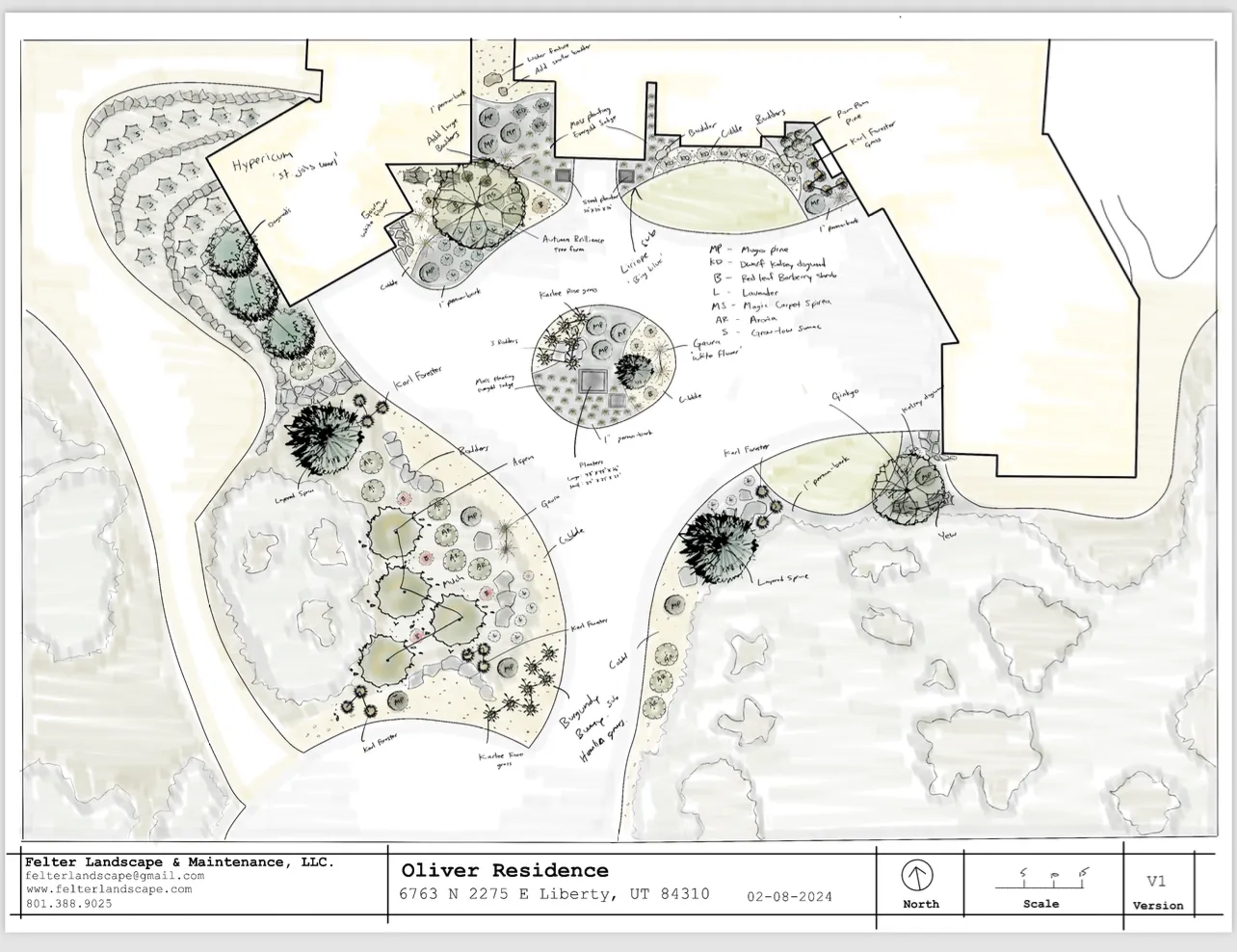
A plan is what makes an estimate accurate. That is the whole reason we start there instead of with a figure. The landscape architect who draws our designs flies a drone over the property for aerial imagery, draws the site to scale, and produces a plant schedule and every piece of hardscape before anyone prices a build. Once that exists, we can put together an accurate estimate.
Design is a separate service and we quote it up front. For larger builds we require a plan before work begins, either ours or one you bring us. Our yard design page walks through how the process works.
What goes into the scope
Ground cover is worth thinking about early. Rock costs more up front and generally needs less upkeep. Mulch is cheaper to install and needs refreshing every year. Over a few years the two totals converge. Jesse is a certified arborist, so mulch is his first choice for plant health, with rock a close second depending on the site, particularly where there is constant wind.
Some parts of a build require a licensed trade. A licensed electrician runs power for a water feature, and a licensed plumber makes the connection at the meter for a gas fire feature. We coordinate both through subcontractors we work with regularly, so you are not chasing separate trades yourself.
Retaining walls are the one part of earthwork that brings permits and engineering into the picture. Grading on its own does not need a permit. Walls can, and the requirements vary by city, including how tall a wall may be before it has to be engineered or stepped back into terraces. We help homeowners find out what their city requires and we work with engineers who stamp the plans.
- Fire features. We only use all-brass burners with a high BTU rating, because plenty of contractors install fire pits that look the part and never throw real heat. A burner like that needs a larger gas line feeding it.
- Lighting. We install warm white fixtures, color matched across the whole range, rather than the blue-white look of cheap online fixtures. We generally steer people away from color-changing systems: each fixture has to be programmed at the controller before it goes in the ground, and one that loses its programming has to be pulled and reprogrammed.
- Soil. On most jobs we bring in premium screened topsoil for the plant beds and under the sod, so things establish well over the first few years.
What we tell people up front
If you are having pavers installed, they should not be sealed straight away. Calcium migrates up through new material and leaves white staining, which is efflorescence. We come back to clean and seal once that has run its course, and we will tell you when the timing is right. Most people are surprised by that, so it is worth knowing it is coming.
The second one is upkeep, and we would rather say it plainly. We install. We do not do maintenance or repairs.
Timing and scheduling
December through February we are effectively shut down for installs. We can still build boulder walls and do dirt work and grading when it is cold and dry, even after a freeze, but sprinklers and sod have to wait for the season.
That off season is the best time in the year to start a design. You get our full attention, because in the spring rush everyone in this trade is slammed. How quickly a plan comes together after that depends almost entirely on how fast you come back to us. Prompt replies keep it moving, and long gaps can stretch it out considerably.
Custom metalwork has its own lead time, because it has to be sourced, welded, sandblasted and powder coated before it ever reaches your yard. If custom metal is part of the design, decide on it early.
Water is worth settling early too. Many Weber County secondary connections are now metered against a seasonal allotment, and conversion incentives can offset part of the cost of moving away from turf. We covered the metering side in our lawn watering post and the rebate side in the park strip post.
Common questions
How much does landscaping cost in Weber County, Utah?
We have not taken on a project under $10,000 in years, so that is the realistic starting point. Beyond the floor we do not publish a price list, because an estimate is only accurate once there is a plan to estimate against. Design is quoted separately and up front, and the build is quoted once the plan exists.
Why does the build price depend on a landscape plan?
A plan drawn to scale, with the plant schedule and every piece of hardscape on it, is what makes an estimate accurate. For larger builds we require one before work begins, either ours or a plan you bring us.
Do you charge for landscape design?
Yes. Design is a separate service, quoted up front. Our 2D plans are drawn to scale by a landscape architect using drone aerial imagery of your property, and they include a plant schedule and all hardscape.
Do you offer landscape maintenance or repairs?
No. We install. We do not do maintenance or repairs.
Do landscapers give free quotes in Weber County?
We provide free quotes across Weber County, including North Ogden.
Sources
Related services and areas: