The strip of grass between your sidewalk and the curb is the hardest-working failure in your yard. It is too narrow to play on, miserable to mow, and nearly impossible to water without soaking concrete. Utah has effectively agreed: the state's water-efficiency standards for new construction now prohibit lawn in park strips and in any planted area narrower than 8 feet at its narrowest point. And for existing yards, there is real money on the table to convert them.
Why 8 feet is the line
Sprinklers need room to throw water evenly. In a strip narrower than 8 feet, spray heads either overshoot onto the sidewalk and street or leave dry stripes down the middle, and there is no schedule that fixes geometry. Add mowing a ribbon of grass between two slabs of concrete and edging it twice, and you get a piece of lawn that often takes more effort and water than it earns back in usefulness. That is why the ordinance language singles out these areas, and why they are the first thing we point at when someone asks where their allotment is going.
Current Weber Basin incentive rates
This is the part most people have not heard. Weber Basin Water Conservancy District offers Flip Your Strip for park strips and the Landscape Lawn Exchange for lawn elsewhere on the property, and the rate depends on your city:
- Flip Your Strip pays $1.25 per square foot for converting a park strip from grass to water-wise planting, and Ogden matches it, bringing Ogden residents to $2.50 per square foot on strips.
- The Landscape Lawn Exchange covers other lawn areas and currently pays $1.25 or $2.50 per square foot depending on the city. South Ogden is currently listed at $2.50 and North Ogden at $1.25.
Check Weber Basin's incentive page for your city's current rate before you plan around the money, because the rates and city list change. We are working on a South Ogden conversion right now where the homeowner is getting the $2.50 rate, so this is not theoretical.
Two rules to take seriously. First, the plan gets approved before any grass comes out: rip out the strip early and you can disqualify the project. Second, Weber Basin's current rules require at least 35 percent of the converted area to be covered by qualifying plants at maturity. All rock does not qualify, and all rock looks worse anyway.
What a converted strip actually looks like
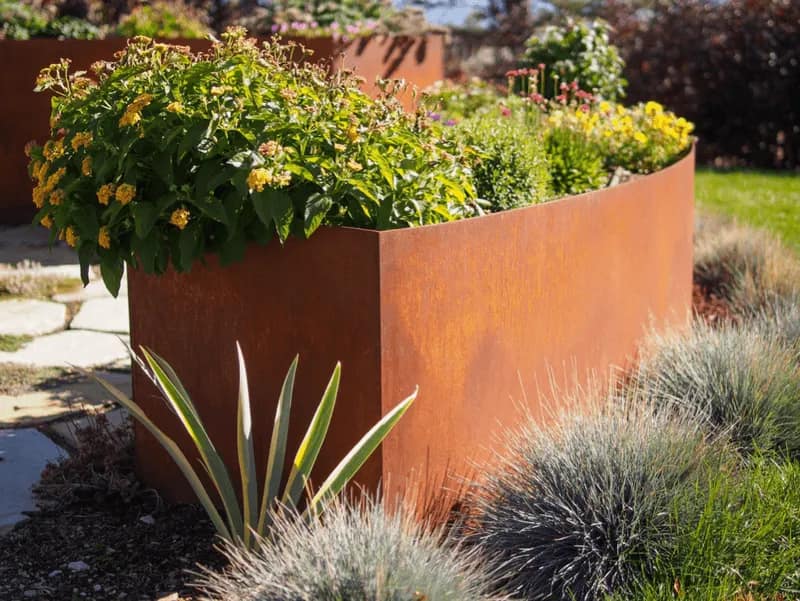
Done right, a converted park strip is not a gravel pit. The pattern that works: a weed barrier and rock or mulch base, drip irrigation run to each plant, and drought-tolerant shrubs, grasses, and small trees spaced so the strip fills in over a couple of seasons. Drip puts water at each root zone with nothing thrown onto concrete, which is the whole problem with spraying a strip. The plant-coverage requirement in the incentive programs pushes the design the same direction we would push it anyway: living plants, low water, no mowing, and a strip that finally looks intentional.
The state's free Localscapes resources have park strip designs if you want to browse ideas, and our yard design work handles the plan, the approval paperwork realities, and the install.
Is it worth doing at rebate rates?
Here is the math. The incentive typically covers a healthy chunk of a do-it-yourself conversion, and part of a professional one. A pro install costs more than the incentive pays. What you are buying beyond the check is the drip system done right, plants that survive, and a strip that needs far less routine work: no mowing, no edging, no overspray, and less of your allotment burned on grass that earns nothing back. With metering now putting a number on every gallon, the strip is usually one of the first areas we would consider converting on a Weber County yard, and we walked through the rest of that priority order in the allotment playbook.
Common questions
Is grass allowed in park strips in Utah?
Utah's water-efficiency standards for new construction prohibit lawn in park strips and in planted areas narrower than 8 feet at their narrowest point, and many cities have adopted matching rules. Existing park strips are generally not forced to convert, but rebate programs pay homeowners to do it voluntarily.
How much does Weber Basin pay to remove grass?
Weber Basin's Flip Your Strip program pays $1.25 per square foot for park strip conversions, and Ogden's city match brings Ogden residents up to $2.50. The Landscape Lawn Exchange covers other lawn areas at $1.25 or $2.50 per square foot depending on the city. Check Weber Basin's incentive page for your city's current rate, and remember the plan must be approved before any grass is removed.
Can I just fill my park strip with rock?
Not if you want the incentive, and we would not recommend it anyway. Weber Basin's current rules require at least 35 percent of the converted area to be covered by qualifying plants at maturity. A strip with drip-irrigated plants over a rock or mulch base uses very little water and looks far better than bare rock.
Who converts park strips in Weber County?
Irrigation and yard contractors handle the design, demolition, drip irrigation, and planting. Felter Landscape does park strip and lawn conversions across North Ogden, South Ogden, and greater Weber County, including projects under the Weber Basin rebate programs.
Sources
Related services and areas: